

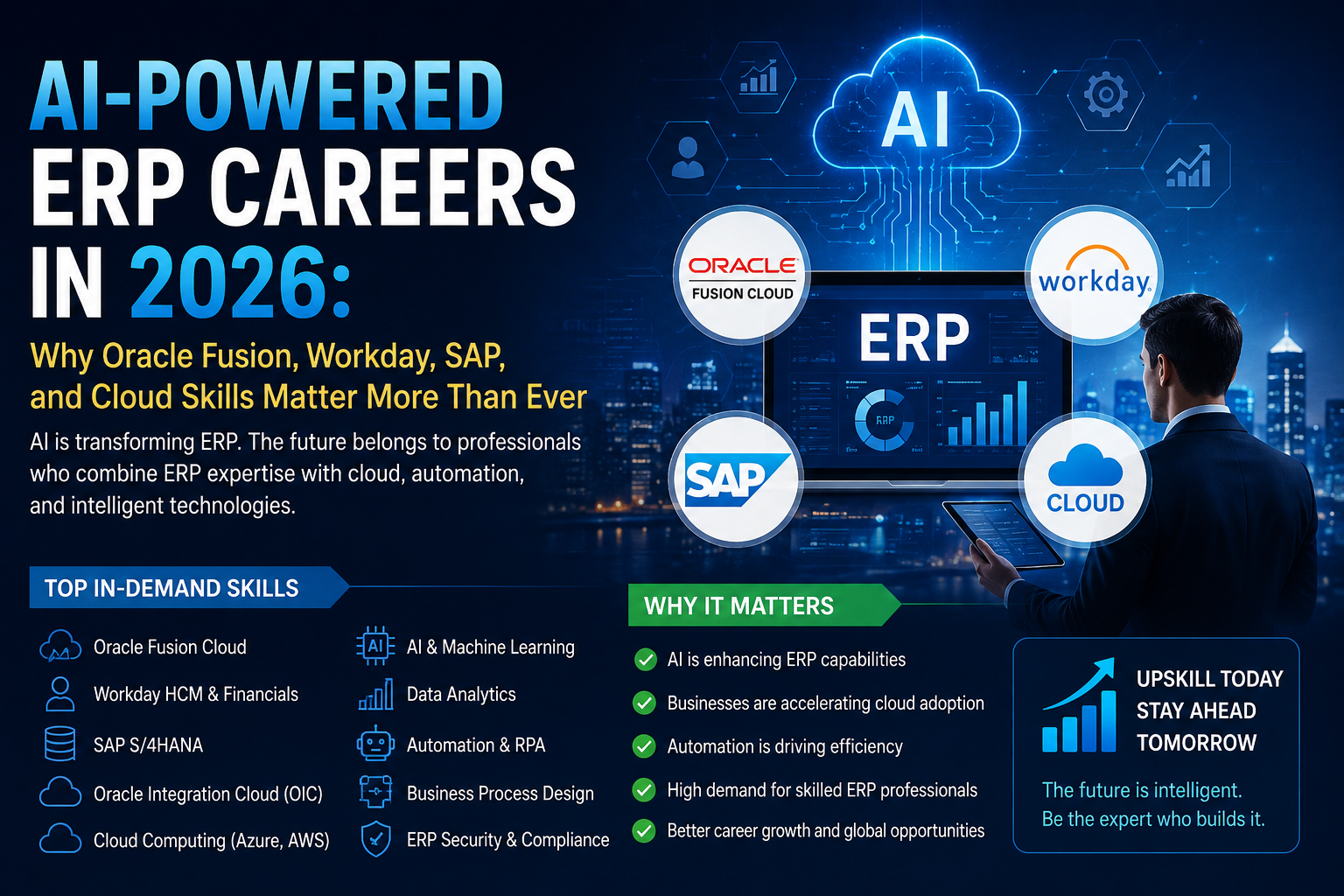
Artificial Intelligence (AI) is reshaping how businesses operate, but it is not replacing Enterprise Resource Planning (ERP) professionals. Instead, AI is changing the way ERP consultants, developers, functional analysts, testers, and administrators work by automating repetitive tasks while increasing the demand for strategic and technical expertise.
Organizations worldwide are investing in digital transformation, cloud migration, intelligent automation, and AI-assisted decision-making. As a result, professionals with expertise in Oracle Fusion Cloud, Workday, SAP S/4HANA, Microsoft Azure, Oracle Integration Cloud (OIC), Snowflake, and enterprise automation are seeing growing career opportunities.
Whether you are a student, IT professional, business analyst, or someone planning a career switch, understanding AI-enabled ERP technologies can help you build a future-ready skill set.
The Evolution of ERP in the AI Era
Traditional ERP systems focused on recording business transactions and producing reports. Modern cloud ERP platforms go much further by integrating AI, machine learning, predictive analytics, and automation directly into business processes.
Today’s enterprise platforms can:
- Predict procurement requirements
- Detect financial anomalies
- Recommend hiring decisions
- Automate invoice processing
- Generate business insights
- Improve supply chain forecasting
- Enhance employee experiences
- Support intelligent reporting
Rather than replacing professionals, these technologies enable ERP teams to make faster, more informed decisions.
Why Oracle Fusion Cloud Is Growing Rapidly
Oracle Fusion Cloud has become one of the most comprehensive cloud ERP solutions available today. It combines finance, procurement, supply chain, human capital management, project management, customer experience, and analytics into a single integrated platform.
Businesses adopt Oracle Fusion because it offers:
- Cloud-native architecture
- Continuous quarterly updates
- AI-assisted workflows
- Advanced security
- Integrated analytics
- Mobile accessibility
- Global compliance features
- Seamless scalability
For professionals, this means increasing demand for specialists in Financials, HCM, SCM, Procurement, Technical Development, Reporting, and Oracle Integration Cloud.
Those looking to build practical skills can explore structured learning resources through Oracle Fusion Training at KinoxTech (https://www.kinoxtech.com/), where learners can gain hands-on exposure to modern Oracle Cloud technologies.
Workday Continues to Expand Worldwide
Workday has become one of the leading cloud platforms for Human Capital Management (HCM) and Financial Management.
Major organizations rely on Workday because of its:
- User-friendly interface
- Cloud-first architecture
- Continuous innovation
- AI-powered workforce insights
- Advanced reporting
- Strong security framework
Workday professionals are increasingly hired for roles such as:
- Workday HCM Consultant
- Workday Payroll Consultant
- Workday Financials Consultant
- Workday Reporting Specialist
- Workday Integration Consultant
- Workday Security Administrator
Learning these skills alongside AI concepts significantly improves long-term career prospects.
AI Is Creating New ERP Career Opportunities
Many professionals worry that AI will replace ERP jobs. In reality, AI is creating new roles while changing existing responsibilities.
Some emerging positions include:
- AI Business Process Analyst
- Cloud ERP Consultant
- Intelligent Automation Specialist
- Oracle AI Implementation Consultant
- ERP Data Analyst
- Integration Architect
- AI Testing Engineer
- Cloud Transformation Consultant
These roles require a combination of technical knowledge, business understanding, communication skills, and practical ERP experience.
Professionals who continuously update their skills will remain highly valuable in the evolving enterprise technology landscape.
Oracle Integration Cloud (OIC): The Backbone of Connected Enterprises
Modern organizations rarely use a single software application. Instead, they operate dozens or even hundreds of business systems that need to exchange information securely and efficiently.
Oracle Integration Cloud (OIC) enables businesses to connect Oracle applications with third-party platforms such as Salesforce, SAP, Workday, Microsoft Dynamics, ServiceNow, and many others.
With OIC, organizations can:
- Automate workflows
- Integrate cloud and on-premises systems
- Build API-based connections
- Synchronize enterprise data
- Reduce manual effort
- Improve operational efficiency
As digital transformation accelerates, OIC skills are becoming increasingly valuable for consultants and developers.
Professionals interested in expanding their Oracle Cloud knowledge can also find specialized Oracle learning paths through Orasol Training Solutions (https://www.orasoltrainingsolutions.com/), which offers training across multiple Oracle technologies and business process areas.